
Abrasion Resistance in PPE: ANSI/ISEA 105-2024 vs EN 388 Explained
Abrasion resistance is a cornerstone of modern PPE design, especially for workers operating in high-wear environments. Whether on construction sites, in automotive shops, or across manufacturing floors, protective gear must withstand constant friction, scraping, and rough handling.
Standards like ANSI/ISEA 105-2024 and EN 388 provide frameworks for testing, rating, and selecting abrasion-resistant gloves. Understanding these standards helps workers and safety professionals choose gear that supports safety, durability, and overall job performance.
What Is Abrasion Resistance?
Abrasion resistance refers to a material’s ability to withstand friction, scraping and surface wear from repeated contact. In PPE, this means gloves, sleeves, and garments that maintain their integrity and protective function during demanding work.
For workers, appropriate abrasion resistance can contribute to:
- Longer-lasting gear
- Reduced risk of wear-related tears or holes
- Better protection against identified workplace hazards
ANSI/ISEA 105-2024 — The North American Standard
Scale and Testing
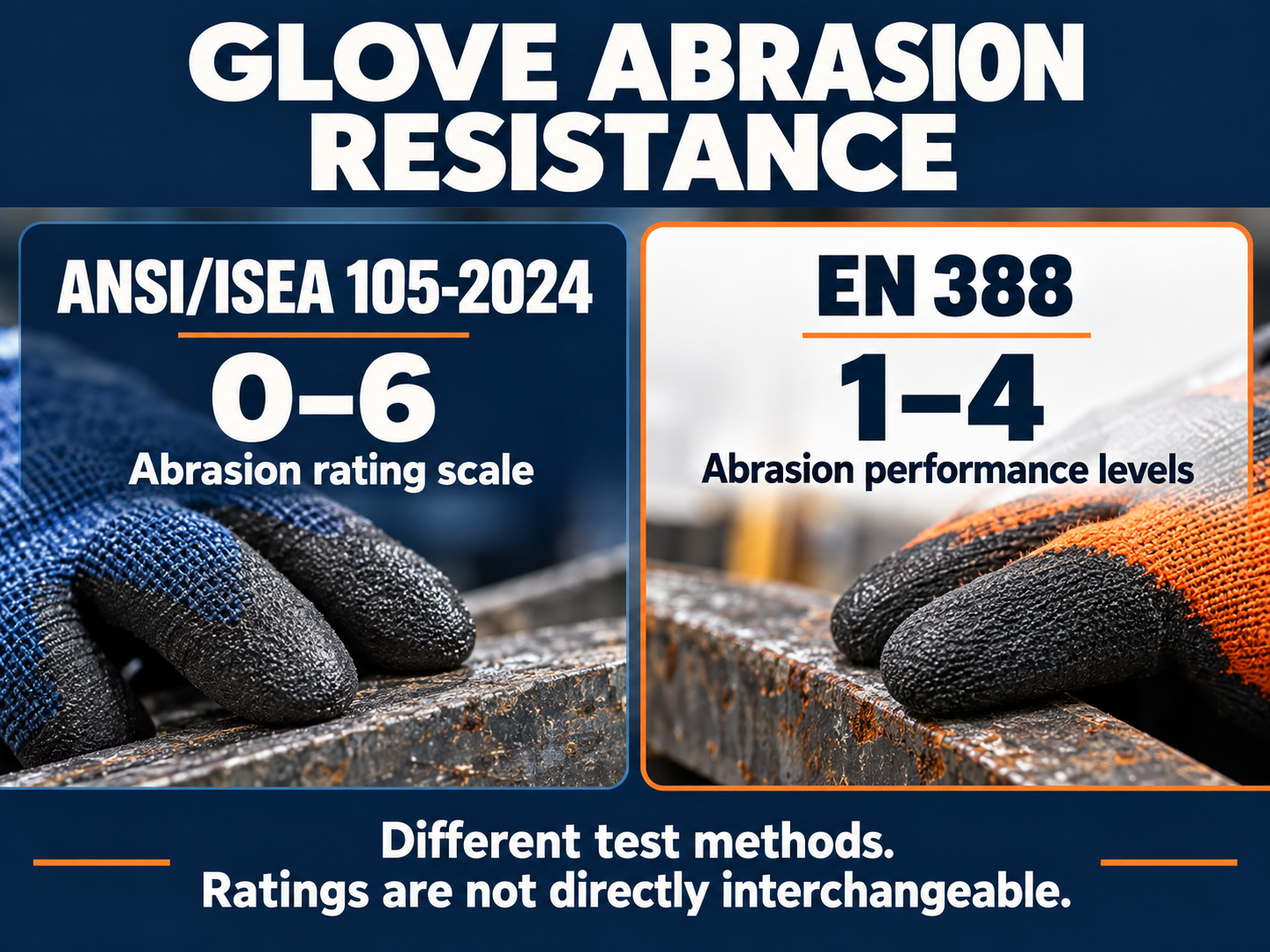
ANSI/ISEA 105-2024 classifies glove abrasion resistance on a 0–6 scale, based on the number of abrasion cycles the material withstands under specified test conditions.
Testing uses a Taber Abraser to measure material wear in a controlled laboratory setting. For example:
- Level 1: At least 100 cycles under a 500 g load.
- Level 6: At least 20,000 cycles under a 1,000 g load.
A higher level indicates greater abrasion resistance under the specified laboratory test conditions; actual glove life also depends on the task and working environment.
What Changed in ANSI/ISEA 105-2024?
The 2024 update primarily improves how existing protection ratings are communicated:
- Improved labelling clarity
- Standardized communication for end users
- Easier identification of the correct PPE for specific tasks
The update does not introduce major changes to test methods or protection levels. Its principal change is how those ratings are displayed.
Labelling System
The ANSI/ISEA 105-2024 pentagon label displays cut resistance at the top, abrasion resistance on the left, and puncture resistance on the right. An X indicates an untested or non-applicable classification.
This visual system supports:
- Quick identification in the field
- Reduced confusion during PPE selection
- Better communication of protective performance
EN 388 — The European Standard
Scope
EN 388 evaluates protection against mechanical risks, including:
- Abrasion resistance
- Cut resistance
- Tear resistance
- Puncture resistance
Abrasion Rating Scale
EN 388 abrasion performance levels range from 1–4:
- Level 1: At least 100 cycles.
- Level 4: At least 8,000 cycles.
Testing involves abrasive paper under standardized conditions.
ANSI/ISEA and EN 388 abrasion ratings use different test methods, so their numerical levels should not be treated as direct equivalents.
Glove Markings Explained
EN 388 markings may include a code such as 4X43F.
In this example:
- The first number represents abrasion resistance.
- The remaining characters communicate blade-cut, tear, puncture, and straight-blade cut performance.
- X indicates that the corresponding classification was not tested or is not applicable.
Understanding this code helps users assess the glove’s documented protective capabilities.
Materials That Improve Abrasion Resistance
Different materials play a key role in enhancing PPE durability.
Leather
Leather can offer:
- Natural abrasion resistance
- Durability for heavy-duty applications
- A practical balance between flexibility and protection
Synthetic Coatings
Common coatings include:
- Nitrile
- Polyurethane (PU)
- Latex
- PVC
Depending on the product and construction, these coatings can:
- Increase surface durability
- Improve grip
- Provide resistance to particular oils or chemicals when supported by product-specific compatibility data
High-Performance Fibres
Engineered fibres such as Kevlar® and Dyneema® can contribute to:
- Abrasion resistance
- Cut protection
- Lightweight flexibility
Performance depends on the finished glove’s construction and documented test results.
Composite Materials
Blended constructions may include:
- Steel
- Fibreglass
- Synthetic fibres
These combinations can enhance protective performance, but comfort and dexterity still need to be evaluated for the intended task.
PPE Design for Abrasion Resistance
Reinforced Zones
High-wear areas often receive extra protection, including:
- Palms
- Fingertips
- Knuckles
Targeted reinforcement can help extend product life where repeated wear occurs.
Ergonomics and Comfort
Effective PPE must balance:
- Durability
- Breathability
- Flexibility
Even a highly abrasion-resistant glove may be unsuitable if it restricts necessary dexterity or contributes to fatigue during long shifts.
Proper Selection Matters
Choosing the right abrasion performance is important:
- Insufficient resistance can lead to premature wear and reduced protection.
- Consider grip, dexterity, fit and cost alongside the required abrasion performance.
Matching PPE to the job supports both protection and practical use.
Choosing and Using PPE Wisely
To get the most out of abrasion-resistant PPE:
- Match ratings to actual workplace hazards.
- Balance protection with comfort and dexterity.
- Review ANSI/ISEA and EN 388 markings before purchasing.
- Ensure proper fit and consistent use.
These steps help workers and purchasing teams select equipment suited to the realities of the job.
The Bottom Line
Abrasion resistance plays a vital role in protecting workers from everyday wear hazards. Standards like ANSI/ISEA 105-2024 and EN 388 provide useful benchmarks for selecting gloves, but understanding how to apply those ratings is just as important.
By choosing gear that balances durability, comfort, and task-specific protection, businesses can reduce premature replacement and support safer, more effective work.
Because when your PPE holds up under pressure, so do you. Contact Stalwart Safety to inquire further.