Cut Resistance: What Really Matters When Choosing Protective Gloves
When selecting or designing cut-resistant hand and arm protection, the most important question isn’t “What’s the cut level?”—it’s “Does it work for your application?”
Cut scores, gram ratings, and standardized levels are helpful benchmarks, but they’re only starting points. The real priority is understanding how the glove will be used, what materials are being handled, and what hazards workers actually face on the job. A glove that performs flawlessly in a controlled laboratory test can still fail in the field if the application isn’t properly understood.
Effective cut protection starts with understanding the environment—not the number on the label.
Materials, Construction & Real-World Function
Today’s cut-resistant technologies are more advanced than ever. Manufacturers use a wide range of engineered yarns and constructions, including:
- HPPE (High-Performance Polyethylene)
- Aramid fibers (e.g., Kevlar®)
- Steel-core or composite blends
- Advanced multi-layer knits
- Durable coatings such as nitrile, polyurethane, and foam grip textures
It’s technically possible to create a glove thick enough—even from cotton—to resist a blade. But the result would be bulky, uncomfortable, and nearly impossible to work in. Conversely, a feather-light glove may score well during testing but lack durability or grip when used on sharp or abrasive materials.
True cut resistance is always a balance of:
- Material type
- Yarn density
- Thickness and construction
- Reinforcements or coatings
- Application-specific grip and dexterity
The right glove is one that matches both the hazard and the task.
Understanding the Standards: ANSI/ISEA 105:2024 vs. EN 388:2016+A1:2018
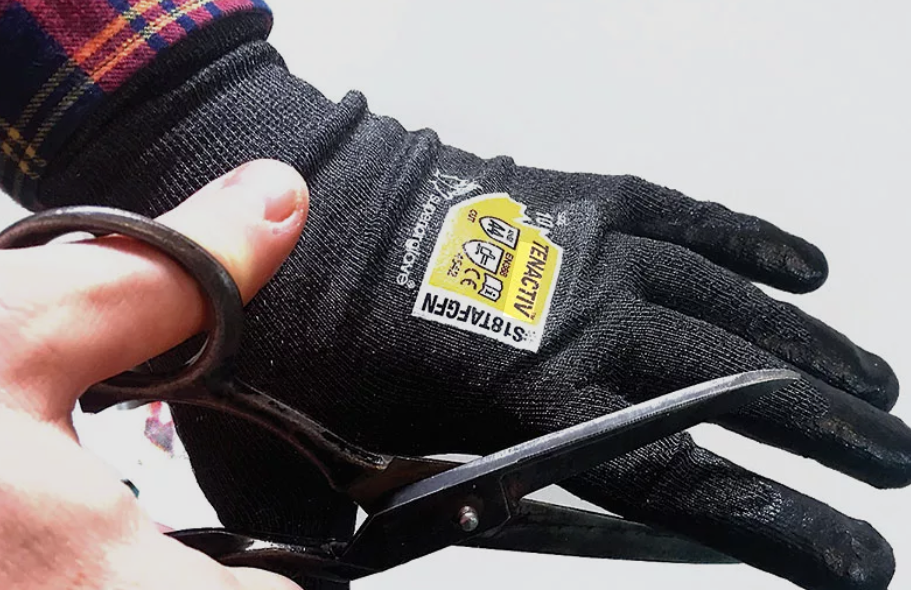
Cut resistance is measured differently around the world. In North America, manufacturers follow ANSI/ISEA 105:2024, while many international markets rely on EN 388:2016+A1:2018.
Although both standards assess cut, abrasion, puncture, and tear, the results are not interchangeable. When someone says “cut level 5,” the first question should always be:
“According to which standard?”
ANSI/ISEA 105:2024 – The North American Standard
The 2024 update continues to use the TDM-100 (Tomodynamometer) method, following ASTM F2992-15.
What’s New in ANSI/ISEA 105:2024:
- Expanded cut scale (A1–A9) for greater precision
- Clearer testing procedures and blade replacement rules
- Updated abrasion and puncture test alignment
- Improved labeling and classification guidance
How the TDM-100 Test Works
A straight blade moves across the glove material under increasing weight until it cuts through. The required grams of force determine the cut level:
| ANSI Cut Level | Weight (grams) |
|---|---|
| A1 | 200–499 |
| A2 | 500–999 |
| A3 | 1000–1499 |
| A4 | 1500–2199 |
| A5 | 2200–2999 |
| A6 | 3000–3999 |
| A7 | 4000–4999 |
| A8 | 5000–5999 |
| A9 | ≥6000 |
EN 388:2016+A1:2018 – The International Standard
EN 388 primarily uses the Couptest, unless the material dulls the blade too quickly—in which case it defaults to the ISO 13997 (TDM) method, similar to ANSI.
How the Couptest Works
A rotating circular blade runs back and forth across the glove material under a fixed load until it cuts through. The number of cycles is compared to a reference fabric to calculate the cut index:
| EN 388 Cut Level | Cut Index |
|---|---|
| 1 | 1.2–2.4 |
| 2 | 2.5–4.9 |
| 3 | 5.0–9.9 |
| 4 | 10.0–19.9 |
| 5 | ≥20.0 |
For tougher materials, the standard switches to ISO 13997, reporting results in newtons (N). Approximate correlation:
- 2N ≈ ANSI A1
- 30N ≈ ANSI A9
Beyond the Numbers: Performance in the Real World
Cut scores provide valuable guidelines but cannot account for every variable in an actual work environment. Factors like:
- Oil, liquids, or chemicals
- Abrasion and vibration
- Sharp edges vs. fine blades
- Grip requirements
- Temperature exposure
- Dexterity needs
- Fit and comfort
A glove rated ANSI A6 may outperform an A8 in real tasks if it offers better grip, better comfort, or coatings that prevent slippage. Likewise, environments with sparks, burrs, steel edges, or moving machinery may require additional reinforcements or flame-resistant materials.
The laboratory provides data—your workplace provides truth.
Conclusion: Numbers Guide You, But Application Decides
ANSI/ISEA 105:2024 and EN 388:2016+A1:2018 give manufacturers and safety professionals a standardized way to measure cut resistance—but those numbers are only one part of the equation.
Real-world performance depends on:
- Understanding your hazards
- Identifying worker tasks
- Evaluating the full environment
- Testing gloves in actual conditions
When you look beyond the cut score and consider how a glove will truly be used, you make better decisions, provide better protection, and keep workers’ hands safer on the job.